Saturday, 9 August 2014

Polar Bear Summer 2014

Churchill is the POLAR BEAR CAPITAL OF THE WORLD for all most all of the year. With the exception of the real winter months when the bears are happily foraging for food out on the ice, polar bears can be spotted. Toward the end of the winter with the bay still frozen but with mama bears and cubs getting ready to come out of their dens, I saw the polar bears tracks big, deep and fresh.


When I arrived on June 4th to begin a birding tour (with the famous birder Rudolf Koes, who proved he was the KING of breeding birds and all flying fowl northern) I did not expect to see polar bears. On day one of the trip, we saw off shore of Cape Merry, on the ice the first polar bears of the season!!!! A mama and two cubs were reclining on the ice and behind them two leisure ring seals. OMG!


   ringed seal             mama                 June 5, 2014                          cubs                        ringed seal

During the rest of the spring/summer season more bears kept showing up. The polar bear "jail" was opened the day I left (that was the open house but no bears were yet incarcerated but that was only a matter of time.
I saw 11 bears and enjoyed the view but was glad for them and ME that the viewing was far enough away to be safe for humans and bears alike.

Near the grounded Ithica.


Ate some insects and shellfish in the kelp and we're off!


Polar Bear Research Winter CNSC 2014

The time I spent at the Churchill Northern Studies Centre brought the northern world to me in an awe-inspiring way that few people will ever know. One of the great privileges I had was getting to know Nick Lunn and Luana Sciullo in their professional capacity as polar bear research scientists and, more importantly, as friends.

Nick, who has been studying polar bears since 1981, venture "home" to CNSC in Churchill twice a year in the spring (frozen February/March) when polar bear moms and babes might venture out of their dens and then again in the fall when big bear season begins in the POLAR BEAR CAPITAL OF THE WORLD. Working with Nick is Luana Scuillo, a Ph.D candidate who focused on fatty acids and environmental change. According to Luana in research done at CSNC and reported in the centre's quarterly magazine,"With this information,
in conjunction with sea ice data (such as thickness and seasonal duration) we aim to investigate any possible correlation between habitat change and diet composition of this particular polar bear sub population. This study will provide important and
necessary contributions to the field of polar bear ecology and Arctic food webs, and will assist to improve management and conservation practices in an otherwise at risk location."

Polar bears are in jeopardy and if you would like to help there are a few ways to do so. One would be to contact Nick Lunn and Luana Scuillo and offer to contribute financially to their research. 
Nick Lunn, the polar bear king nick.lunn@ec.gc.ca
Luana Scuillo  lscuillo@gmail.com

Linking with Environment Canada http://www.ec.gc.ca/scitech/default.asp?lang=En&n=F97AE834-1&formid=9617A9C7-98B9-42DA-B999-F3CBC309F029&xsl=scitechprofile is also a ggod connection.

Here are some photos of Nick and Luana going to their research and some polar bear and caribou pic taken on their research by Luana.

Caribou from the helicopter

Earley ice melt in Hudson Bay

                                                                  Mother and cubs

Ahh, save me...


Luana and Nick from the cafeteria window exiting the heli after a day searching for polar bears.


The Northern Lights winter 2014 Churchill, Manitoba

Geoff Kinsey
While I was in Churchill this year during the winter of 2014 ( really the main reason I went to Churchill) I was able to view the Northern Lights, the Aurora Borealis. In order to experience this celestial light show you really need to be in a very high latitude and have a beautiful clear night. I saw the most outrageous exhibits of the phenomenon during the weeks I was volunteering at the Churchill Northern Studies Centre in mid-winter (February to mid March) in extremely cold, crisp weather between 10 pm and 2 am.                                   

What causes the Aurora? Some Inuit believed that the spirits of their ancestors could be seen dancing in the flickering aurora. In Norse mythology, the aurora was a fire bridge to the sky built by the gods. Science says that when charged particles from the sun strike atoms in Earth’s atmosphere, they cause electrons in the atoms to move to a higher-energy state. When the electrons drop back to a lower energy state, they release a photon: light. This process creates the beautiful aurora, or northern lights. I say the Aurora is another reason to explore this dynamic and mysterious world in which we live.

The following are a few of the simple photos I took with a compact Sony camera on a tripod with very little expertise. Follow through until the end and you will see fantastic shots from some of my friends who were there with me and really know how to capture the show!

My shots:


  Now some shots from the many wonderful people I met during my stay at CNSC winter 2014. First, Brian Friedman, a coworker and great buddy!


Brian 's fisheye
 Shots from researchers from the Earth watch team. Jamie's are Aurora and picture                             the igloo her team created!


   Matt Hudson:


Kumar, who shared my flask!


Finally, an unbelievable time lapse video made by Alan Dwyer, astronomer, author and, obviously, astounding photographer from the Aurora on my birthday, February 7th, 2014!


          Click and view the time lapse of the Aurora on my birthday, February 7, 2014:
                      (I am in the picture excitedly jumping up and down with a friend.)


Thursday, 6 March 2014

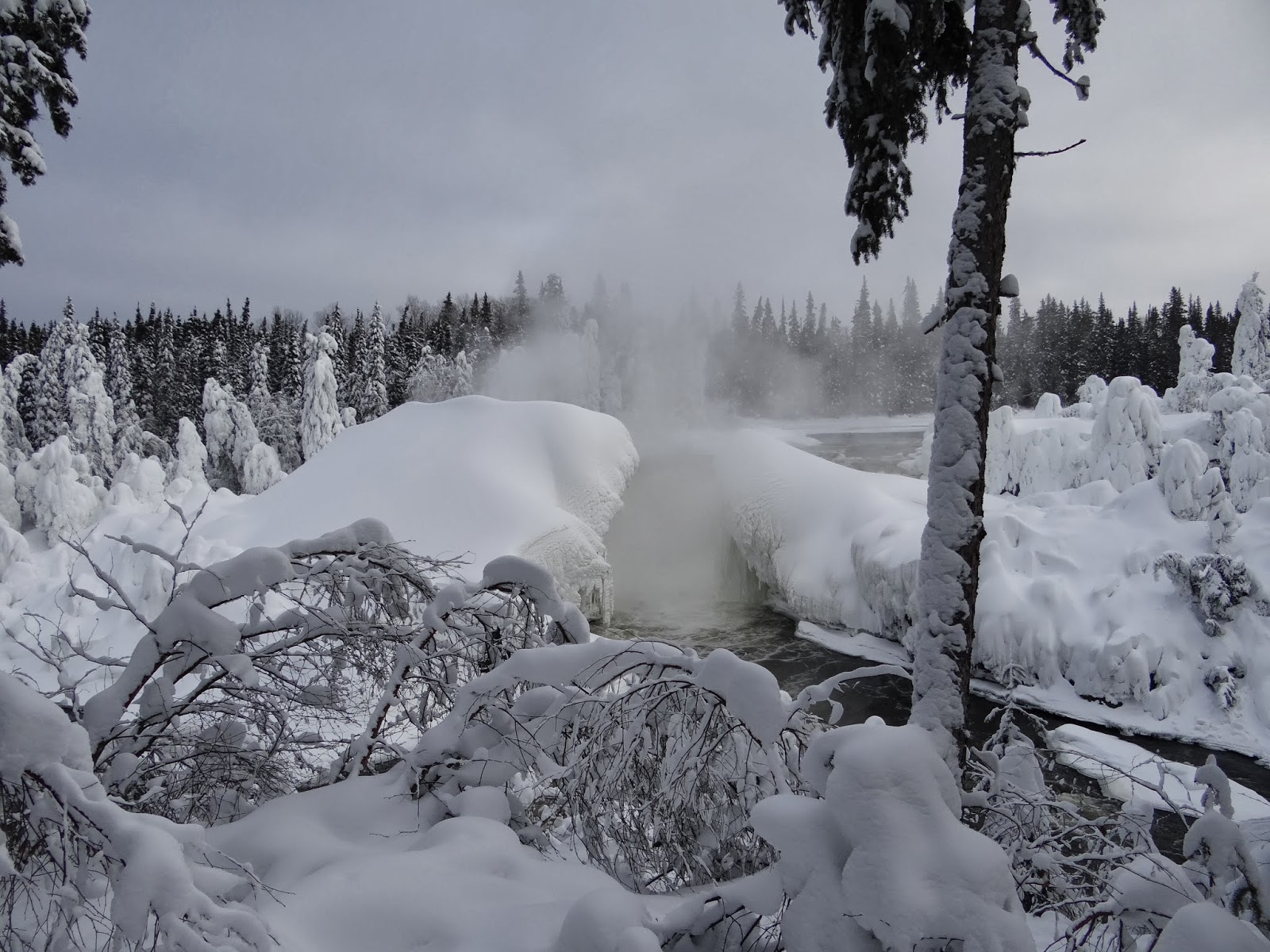
Pisew Falls, Manitoba FROZEN!

 The VIA Rail train stops for 5 hours at Thompson and my during that stop it is possible to see some sights around the town.
                                                                           
VIA Rail stop at Thompson


Pisew Falls is located approximately 45 minutes south of Thompson. A 0.5 kilometer trail brings you to a viewing platform, perfect for snapping shots of the 13 meter high falls.
Also located at the second largest falls in Manitoba is a suspension bridge that spans the lower falls. This bridge is the starting point of a seven-mile hike that brings you to the highest waterfalls in Manitoba-Kwasitchewan Falls.


Back to the train